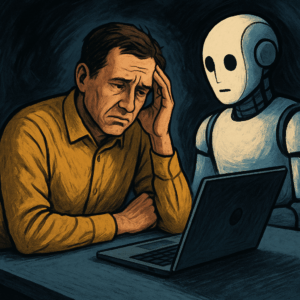
A friend once told me you know that, “I talk to ChatGPT more than some people.”
We laughed, but later, I couldn’t stop thinking about it. That sentence said everything. It captured something quietly profound about the times we’re living in—something many of us feel but haven’t fully named. Since ChatGPT entered our lives, we’ve praised its impact on productivity, content creation, customer service, and learning. And it has changed the game.
But beneath all that utility, there’s something deeper happening., It’s not just how we work that’s changing.
It’s how we behave., It’s how we connect., It’s what we avoid.
We’re not just using ChatGPT. We’re revealing ourselves through it.
We use it to co-write blog posts and brainstorm ideas. But also to vent frustration. To rehearse tough conversations. To ask, “What should I do?”
We say “please” and “thank you” to a machine.
We give it personalities, name it he or she.. . We expect empathy. We feel seen—sometimes more than we do by people.
Some feel empowered. Others feel unsettled.
That’s not AI being human. That’s humans being… human.
We’ve entered the era of co-creation.
Generative AI has shifted the landscape. Content that took hours to produce now takes minutes. Emails are tone-adapted. Reports are auto-summarized. Learning is personalized.
GenAI enables a kind of speed, personalization, and accessibility that we’ve never seen before.
In healthcare, it helps build patient-specific treatment paths. In customer service, it provides real-time, hyper-personalized support. In business strategy, it accelerates insights from months to minutes.
This isn’t just automation—it’s augmentation. Creativity meets code.
But let’s not forget: technology reflects our intent.
And intent can be messy., We’re seeing early signs:
- People becoming more isolated, substituting conversations with AI.
- Users becoming over-reliant, trusting blindly, thinking less critically.
- AI being used to scale misinformation, social engineering, or targeted manipulation.
It’s not because ChatGPT is bad. It’s because it amplifies what’s already there.
If we’re biased, it reflects that. If we’re avoidant, it enables that. If we’re curious and open, it empowers that too.
So, no—ChatGPT isn’t evil. It’s a mirror.
It doesn’t corrupt. But it can reveal. It doesn’t isolate. But it can enable hiding. It doesn’t manipulate. But it can magnify.
The challenge isn’t “what AI will become.” It’s who we’re becoming while we use it.
So what do we do now?
We stop fighting the wrong enemy. Technology isn’t the villain. It’s a mirror—and a multiplier.
Let’s not fear it. Let’s teach.
Let’s show kids, workers, leaders—everyone—how to use AI thoughtfully. How to question it. How to challenge it. How to partner with it. How to use it ethically, creatively, and responsibly.
The question is not whether we should use AI. It’s whether we can grow alongside it, without losing what makes us human.
Because in the end, technology will be as good—or as harmful—as we choose to make it.